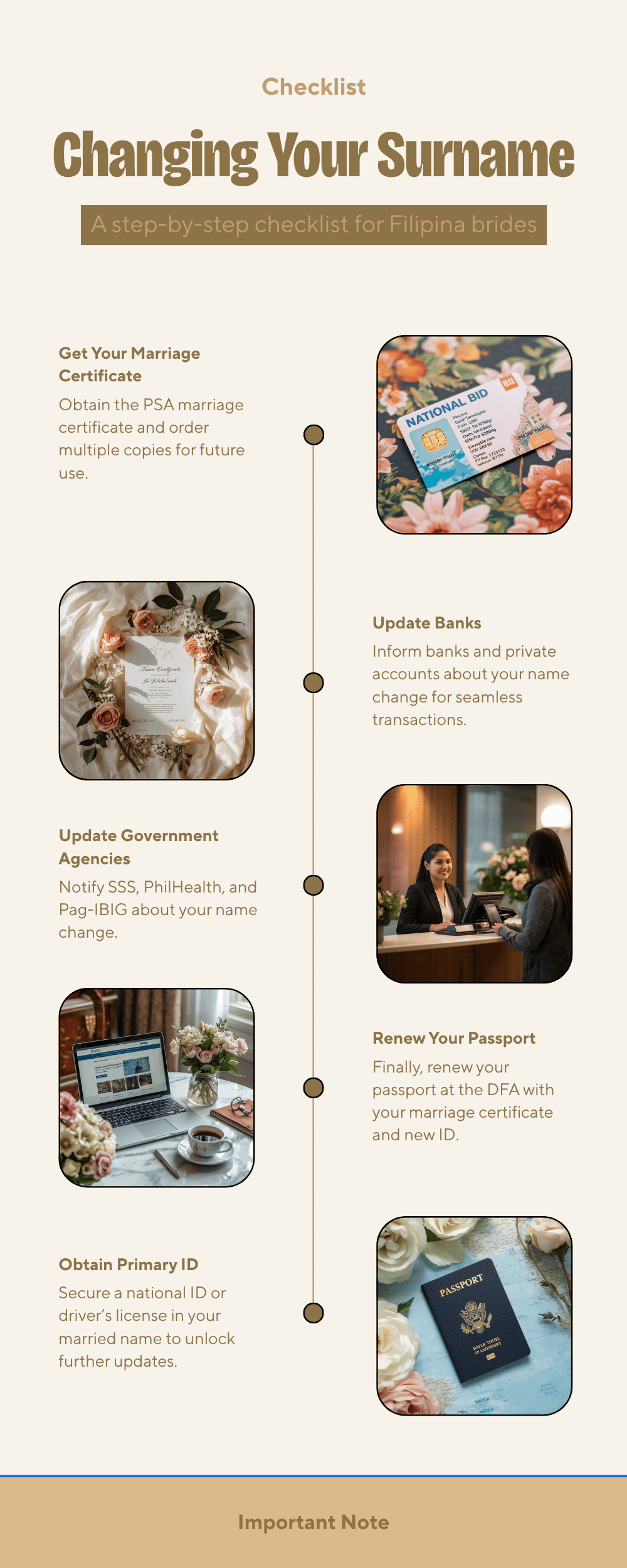
The wedding is over, the photos are in, and then a courier squints at your ID because the name on the parcel doesn’t match. Or payroll asks which surname to put on your BIR form. Changing your name after marriage is the part of the wedding nobody plans for, and the paperwork has an order to it. Follow that order and most of it is free. Ignore it and you’ll make the same trip three times.
Here’s the whole map, from one Cebu wedding planner who has watched a lot of couples work through it.
First: you don’t actually have to change it
This surprises a lot of Filipina brides. Article 370 of the Civil Code says a married woman may use her husband’s surname. May, not must. There is no law requiring you to change anything, and the Supreme Court confirmed as much in Remo v. Secretary of Foreign Affairs, describing it as an option rather than a duty.
Your choices are:
- Keep your maiden name exactly as it is
- Maiden first name and maiden surname, plus his surname (Juana Reyes Cruz)
- Maiden first name plus his surname (Juana Cruz)
- His full name with a prefix (Mrs. Juan Cruz)
Plenty of brides keep their maiden name for professional reasons, especially if they’re licensed, published, or have property and business documents in that name. Neither choice is more valid than the other. What matters is picking one and being consistent everywhere, because mismatched records are what cause the real headaches later.
May, not must. The law gives you options, not an obligation.
Step 1: Get your PSA marriage certificate (and start early)

Everything downstream depends on this one document, and it is the step couples underestimate most.
Your marriage certificate does not exist at the PSA the moment you say I do. Your officiant files it with the Local Civil Registrar, the LCR transmits it to the PSA, and only then can you request a copy. That pipeline commonly takes two to six months, sometimes longer for weddings outside the city.
Two pieces of practical advice. Follow up with your officiant or the LCR a few weeks after the wedding to confirm the certificate was actually filed. And when you do request copies, order several at once. Nearly every office below wants an original, and some keep it.
Step 2: The free government updates
Do these before anything that charges a fee. They’re straightforward, they’re free, and they build the paper trail the harder updates will ask for.
- SSS: member data change form plus your PSA marriage certificate and valid IDs, filed at any branch.
- PhilHealth: member registration form ticking the update option, with the same supporting documents.
- Pag-IBIG: member’s change of information form, same documents again.
- BIR: Form 1905 at the RDO where you’re registered. Do this one properly, because a mismatch between your BIR record and your employer’s payroll causes problems at tax filing.
If you’re employed, tell HR once these are done so payroll and your contributions line up.
Step 3: Get one primary ID in your married name
This is the step that unlocks everything else, and doing it here rather than later is what saves you repeat trips.
Banks, the DFA, and most private institutions want a government ID that already shows your married name. Your PSA certificate alone often isn’t enough. The two practical options are your PhilSys national ID and your LTO driver’s licence. Update whichever you can get soonest, then use it as your anchor document everywhere else.
Also worth updating around this point: your voter registration with COMELEC, and your PRC licence if you hold one. PRC requires a notarised petition form and a small fee, so factor in the extra step.
Step 4: Banks, insurance, and everything private
With a primary ID in hand, banks are usually a single visit. Tell them you’re updating your personal information, bring the PSA certificate and your new ID, and sign the forms. Do the same for insurance policies, investment accounts, credit cards, your employer’s HMO, and any property or business documents in your name.
Don’t forget the small ones people skip and then trip over: e-wallets, online shopping accounts, and airline loyalty programmes. A ticket that doesn’t match your passport is a genuinely bad discovery at check-in.
Step 5: Your passport, and what changed in the law
Leave this until last, because the DFA wants your other documents to already agree with each other.
An important point of confusion: the DFA doesn’t amend your existing passport. You renew it, and surrender the old one. Book an appointment online, bring your PSA-authenticated marriage certificate (or Report of Marriage if you married abroad), your current passport, and a valid ID in your married name.
The rules here were modernised by the New Philippine Passport Act, Republic Act No. 11983, enacted in 2024. Two parts matter to newlyweds. Using your husband’s surname requires a PSA-authenticated marriage certificate. And a married woman may now voluntarily revert to her maiden name, but only once, and only if her other IDs and documents already show the maiden name. Reversion after annulment, nullity, legal separation, a judicially recognised foreign divorce, or the husband’s death follows a separate route requiring an annotated PSA certificate or death certificate.
That once-only reversion is the detail worth pausing on. Under the older rules this was considerably harder, which is why some outdated advice online says it’s impossible. It isn’t, but it’s not something to treat casually either.
Everything at a glance
| Where | What to bring | Cost |
|---|---|---|
| PSA | Request form, valid ID | Per copy fee |
| SSS | Member data change form, PSA certificate, 2 IDs | Free |
| PhilHealth | Member registration form, PSA certificate, ID | Free |
| Pag-IBIG | Change of information form, PSA certificate, ID | Free |
| BIR | Form 1905, PSA certificate, ID | Free |
| PhilSys / LTO | PSA certificate, existing ID | Varies |
| COMELEC | PSA certificate, ID | Free |
| PRC (if licensed) | Notarised petition, PSA certificate, photos | Small fee |
| Banks | PSA certificate, new ID | Usually free |
| DFA (passport) | PSA certificate, old passport, new ID | Renewal fee |
A realistic timeline
Two to six months waiting for the PSA certificate. A few weeks working through the free government agencies. Another few weeks for a primary ID. Then banks and passport as your schedule allows. Most brides are fully updated somewhere between six months and a year after the wedding, and that is completely normal.
One thing that genuinely helps: keep a single folder, physical or digital, with scans of your PSA certificate, your old and new IDs, and every reference number you’re given. You’ll reach for it more often than you expect.
Before you start
Requirements and fees at each agency do change, so confirm the current list on the relevant agency’s website or by calling your local branch before you travel. If your situation involves annulment, a foreign divorce, a marriage recorded abroad, or an error in your civil registry record, talk to a lawyer rather than relying on a checklist, including this one.
And if you’re still in the planning stage, the smoothest surname changes we see are the ones where the couple confirmed their marriage certificate was properly filed in the first month. It costs you one phone call and saves months.
Planning your wedding in Cebu? We handle the details couples don’t think to ask about, including making sure your paperwork is filed correctly after the day. Book a free consultation and let’s talk about your day.

